By Jarod Reibel
It’s 3 a.m. on a Saturday morning, and while most people are sleeping in their warm beds, the lights in the Tower of Tomorrow kitchen flip on as our Guest Services team reports to work. The smell of bacon, gravy and coffee quickly begins to drift out of the kitchen’s double doors.
By 5 a.m., headlights begin to fill the parking lot. About 30 people make their way inside, most draped in camouflage pants and perhaps their lucky blaze orange hat. The room fills with chatter. It’s Michigan’s unofficial holiday: Nov. 15, the opening day of firearm deer season.
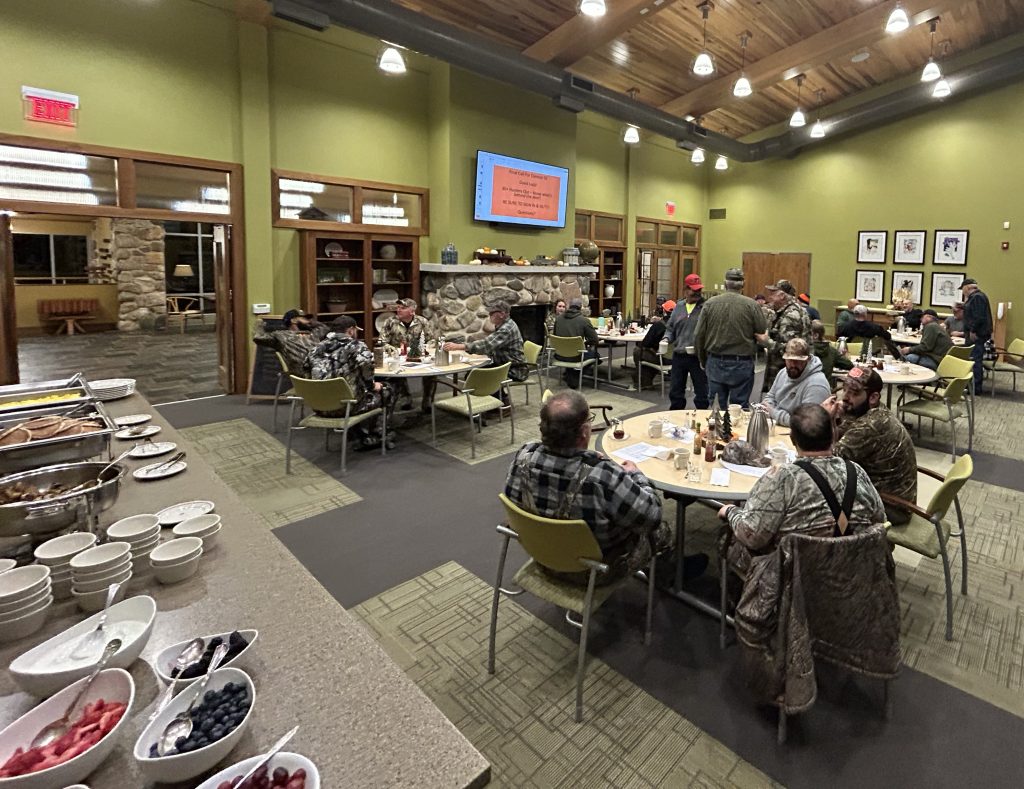
This recent Nov. 15 marked our 35th annual deer hunter’s breakfast. The event allows our hunters to come together and review our guidelines, understand where everyone will be stationed, swap contact information, and perhaps partake in some friendly trash talk regarding who the lucky hunter will be that morning. After about an hour, the Guest Services team is met with a round of applause, for they are the true stars of the show. Their handiwork includes a hearty buffet of eggs, crispy bacon, pancakes, potatoes and fresh fruit, along with some warm soups for a mid-day lunch break later on.
With full bellies and one last sip of coffee, the hunters slip out into darkness, finding their way to their spots. There, they wait for the sun to come up and reveal the landscape, hopefully with some deer around them. Off in the distance, a shot rings out. A lucky hunter happened to be in the right place, at the right time. Soon another shot can be heard in the opposite direction.
During the first couple days of firearm season, a large portion of Big Rock Valley’s (BRV) annual deer harvest occurs. Although many hunters hope to harvest a buck, we emphasize does, as they are the portion of the population that drives overall herd size.
Indeed, the reason for our hunting program is to keep BRV’s deer population at a sustainable, healthy size. Back when our founders, Ed and Darlene Lowe, resided at BRV, deer were not hunted. And with 2,000 acres of food and cover, their population exploded far above what the land could handle, resulting in severe overbrowsing of vegetation and an overall unhealthy landscape. The property made it clear that intervention was needed, which led to the development of our employee hunting program.
Since then, we have sectioned the property into different hunting zones based on logical breaks like roadways, valleys or creeks. Each fall employees who wish to participate in the program are able to pick a zone to hunt. Zone selection is based on seniority, with the first picks going to those who have worked for the foundation the longest. This process ensures all employees and their families have their own space, while also enabling us to reduce negative impacts from deer in all sections of the property.
We’ve also developed guidelines to ensure that hunting activities can safely co-exist with the foundation’s regular operations, which include:
- Where hunting is allowed.
- What days and times hunting can occur.
- Registering any harvested deer for our records.
- Hunters signing in and out each time they are on the property.
- Reporting how many deer they see while at BRV.
These guidelines enable the foundation to track the size of our deer population and make harvest recommendations based on the data. Though not a perfect science, as population increases, the number of deer seen from the field per unit of time should also increase, and vice versa when population decreases. This allows us to measure if we are removing enough deer from the landscape to maintain healthy population levels — or whether we need to increase or decrease harvest rates.
Nearly 40 years later, this program continues to serve as a pivotal tool in maintaining the health of the herd and our property. What’s more, it’s a great perk for employees who enjoy hunting, and it allows us to donate extra venison back into communities of need.