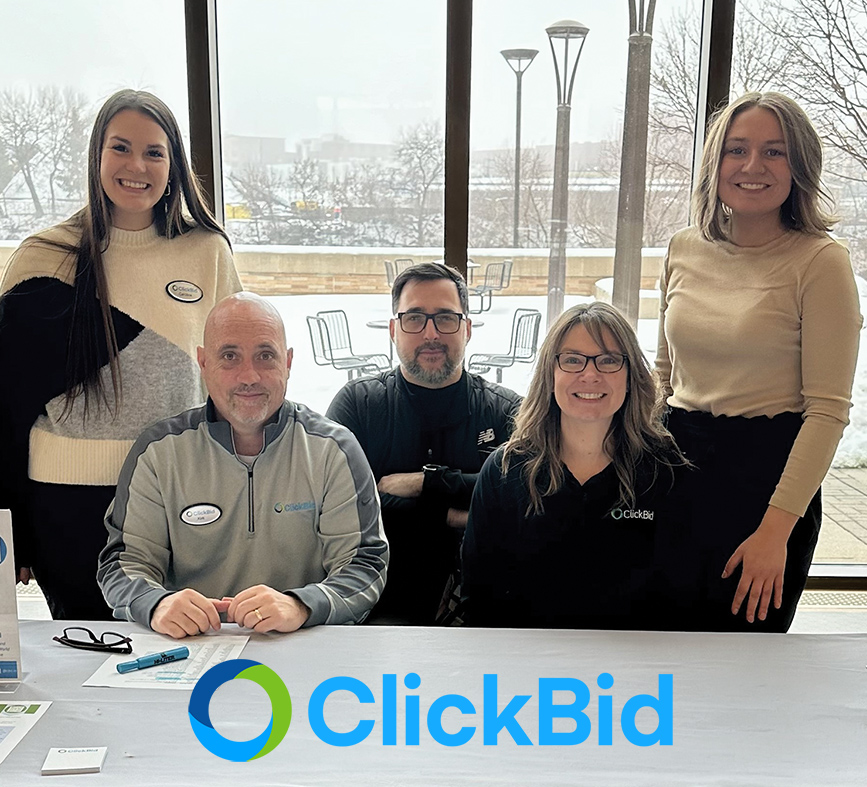
A pioneer in the online fundraising space, ClickBid has been helping nonprofits produce stellar events, from 5K races to black-tie galas, for more than two decades.
The back story: After studying video production and computer science in college, ClickBid founder Matthew Burnell worked as a freelancer in the film industry, including gigs on the set of Rob Reiner’s “Flipped” and Ruben Fleischer’s “30 Minutes or Less.” Yet Burnell also had a passion for philanthropy, and in 2002 he built an electronic auction service for the Hospice of Michigan. Burnell continued to scale the software platform, attracting other nonprofit clients, and he formally structured ClickBid as an LLC in 2010.

Since then, Burnell and co-owner Tom Huneke, who joined the business in 2012, have grown ClickBid to more than 20 employees and $5 million in revenue. Based in Norton Shores, Michigan, the company now produces more than 4,000 events annually, including fundraisers for Heart Gallery Alabama, Knights of Columbus, Al Sigl Community of Agencies and Feeding America Eastern Wisconsin.
ClickBid’s fundraising software has evolved beyond auctions to handle everything from ticketing and payment processing to video streaming. It integrates easily with large systems like Salesforce, and in contrast to per-event pricing models, ClickBid charges a flat annual fee in order to make costs more predictable for clients.
In 2023 ClickBid introduced an AI assistant, AuctionGPT, which helps clients generate descriptions for auction items, donor communications and event analysis. Yet Burnell remains cautious about the extent that ClickBid embraces AI.
His rationale: AI often generates more, not less, work for employees by producing questionable results that must be verified. And when results turn out to be inaccurate, greater time and effort is required to correct the product or project. “I’m fortunate to have an incredibly talented workforce,” Burnell says. “I see value in AI if it can help them by removing some of the ‘what, where and how’ questions so they can be more thoughtful about ‘why’ questions.”
This is important because being “obsessive about support” is a core competency for ClickBid. Annual license fees include onboarding, pre-event walkthroughs, and email, chat and phone support — including someone on call during the fundraiser, which often falls on a weekend or evening. ClickBid staff will even show up in person at clients’ request, and software engineers frequently attend events to watch how their platform is being used.
ClickBid’s real-person support is critical when the unexpected happens, such as an auctioneer selling more items than exist in inventory, a board member trying to pay with a declined credit card, or a connectivity issue caused by a laptop on the wrong network. Even offsite, experienced staffers can pinpoint the source of a problem and resolve it with speed and discretion. “With live events, you don’t get to pause, start over or do a take two,” Burnell says. “Whether communications happen over the phone, text or onsite, our people understand what can go wrong — and how to fix it.”
As ClickBid continues to grow, Burnell credits programs from the Edward Lowe Foundation for helping him add stability by introducing operational infrastructure, such as processes, procedures and an org chart with well-defined roles. “This doesn’t sound very glamourous,” Burnell says. “For a visionary like me, I would love to attribute our success to a new product or innovation, but our processes and org chart are what enables everyone to operate in their lane of expertise — and without me if I need to go out of town.”
Retreats at Big Rock Valley have also been valuable for Burnell to gain new insights as a second-stage leader. “The thoughts that normally hit my brain first thing in the morning don’t show up here in the same order or with the same weight,” he explains. “At Big Rock Valley, you get a chance to process differently. Old assumptions loosen up. Questions you’ve been avoiding have room to surface because there’s nothing competing for the space.”
In film production, an editor’s primary job is to compress time so the audience is not distracted, he continues. “And that’s what the foundation does. It creates an environment of immersion so you don’t get pulled out of the experience in any way.”